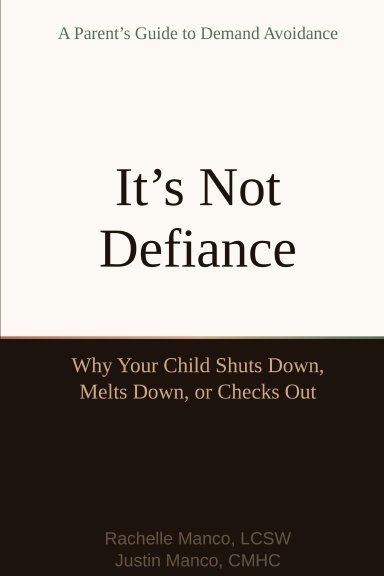
It's Not Defiance

Why your child shuts down, melts down, or checks out. A parent's guide to demand avoidance, from toddlerhood through young adulthood. Built on the RELATE framework.

Four parts. One framework. Every age.

Part 1: Start With Yourself

Your nervous system, your burnout, your demand-placing patterns, and your capacity for repair. This book starts with you because you are the single largest variable in your child's environment.

Part 2: Understanding & Applying RELATE

What demand avoidance actually is, the six RELATE pillars translated for home life, the ADAPT crisis protocol, and daily scenarios with specific guidance for the moments that matter most.

Part 3: The Long Game

Taking care of yourself for the long haul. Talking to your child's school, therapist, and support team. Sustaining the approach when the world does not accommodate it.

Part 4: Teen & Young Adult Years

When autonomy is no longer yours to grant, the demands are bigger, and the relationship has history. School refusal, substance use, gaming, launching, and the questions that keep you up at night.

You picked up this book because nothing has worked.

You have tried sticker charts, consequences, rewards, therapy, and every parenting approach you could find. None of it produced lasting change. Your child shuts down over shoes. Melts down over homework. Checks out when the demands of ordinary life exceed what their nervous system can carry.

This book explains why. Some children's nervous systems register everyday demands as survival-level threats. The response looks like defiance. It is not. It is a neurological mechanism called demand avoidance, and once you understand it, every failed strategy suddenly makes sense.

This book works for families with or without a formal diagnosis. If the description fits your child, the framework applies.

Frequently asked

How is this different from other PDA parenting books?
This is a parent book built on a structured clinical intervention framework. RELATE was developed by licensed clinicians from direct work with the most complex neurodivergent populations in residential and intensive outpatient settings. Most PDA parenting books describe the profile. This one gives you a framework with specific tools for every situation.
Does it cover teenagers and young adults?
Yes. Part 4 is dedicated entirely to the teen and young adult years, covering the autonomy shift, school dropout, substance use, gaming, the young adult who won't launch, and the questions that keep parents up at night. The book covers ages 3 through young adulthood in one volume.
Do I need a PDA diagnosis for my child to use this?
No. Formal PDA diagnosis is inconsistent, expensive, and often inaccessible. If your child's nervous system responds to everyday demands with avoidance, shutdown, or meltdown, the framework applies regardless of what is on paper.
Is this the same as the professional manual?
No. The RELATE Foundational Training Manual is a 196-page clinical training document written for professionals. This book is written for parents in a voice that meets you where you are. Same framework, different audience, different depth. If you want your child's therapist or school team to understand RELATE, the professional manual is available at relatepda.com/manual.
Is it available on Amazon?
Yes. The book is available on Amazon with worldwide shipping.
Can I bring this to my child's therapist?
Yes. The book includes a one-page summary designed to be shared with your child's school team, therapist, or any professional who supports your family. Hand them the book or hand them the summary. Either one gives them more useful information than most intake forms collect in an hour.

Want the clinical framework behind this book?

The RELATE Foundational Training Manual is the 196-page professional training document this book is built on. For clinicians, educators, and allied professionals.

View the Manual Contact Us