Clinical tools for the PDA field.

You can identify PDA. You know what you're looking at. But when it's time to intervene, the field gives you almost nothing. RELATE was built to fix that: a structured framework, named protocols, assessment instruments, and implementation phases designed for the settings where PDA is hardest.

RRelationship
EEmpathy
LLower Demands
AAdjust
TTime
EEnvironment

Mechanism-based, not rule-based

Every RELATE strategy ties to a specific nervous system mechanism: autonomy threat, intolerance of uncertainty, neuroception, amygdala-prefrontal cortex threat circuitry, and autonomic regulation. When a strategy doesn't work, mechanism knowledge tells you why and what to try next.

RELATE

Six-pillar framework for ongoing support. Assessment-driven, phased implementation with readiness gates.

ADAPT

Five-step triage protocol for crisis response. Assess, Decrease, Align, Pace, Test.

5 Instruments

RELATE Assessment (clinician, parent, adult self-report), Demand Audit, Supporter Self-Assessment.

3 Phases

Supporter Readiness, Active Framework, Maintenance and Generalization.

Full Framework Details

Where to start

Whether you're a solo clinician or a residential program with 50 staff.

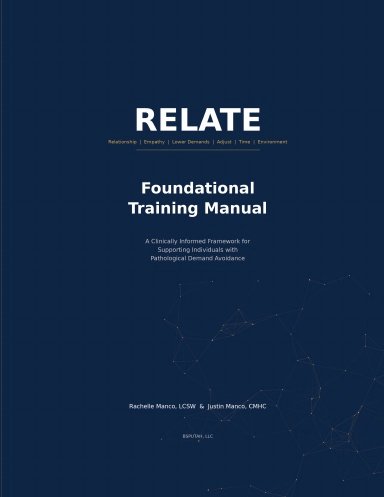
RELATE Training Manual

Training Manual

The complete 16-chapter clinical training manual. Five assessment instruments, ADAPT protocol, implementation guides, and quick reference cards. 196 pages.

Learn More

Team Training

Live virtual or on-site training by the framework developers. Customized to your setting, your population, and your team's experience level. Includes manuals for all staff.

Interested in training for your program? We're happy to talk about what you need.

Get in Touch

Built for the settings where PDA is hardest

Residential & Hospital Programs Staff training for treatment centers, psychiatric hospitals, crisis stabilization units, and group homes.
Clinicians & Therapists Psychologists, social workers, counselors, BCBAs, and anyone providing direct clinical services.
Schools & Educators Special education teams, school psychologists, and paraprofessionals working with demand-avoidant students.
Allied Health OTs, SLPs, and support professionals integrating demand-aware strategies into their practice.

Clinical insights on PDA intervention

How to Treat PDA: A Therapist's Guide to What Actually Works

You've identified the PDA profile. Now what? Here's where to start when the field gives you almost nothing.

PDA Staff Training for Residential Treatment

Residential care is a demand environment by design. Here's what PDA-informed staff training looks like.

PDA Demand Reduction Is Not Permissiveness

The most common criticism of low-demand approaches, and the clinical distinction that answers it.

PDA vs. ODD: Why So Many PDA Individuals Are Misdiagnosed

Similar surface presentations, completely different mechanisms, and critical treatment implications.

All Professional Posts

Questions?

We're happy to talk about your setting, your team, or how the framework applies to your population.

Get in Touch