You Were Never Broken Is Now Available
We wrote You Were Never Broken because the people who needed the RELATE framework most couldn't get to a clinician who understood it. The book is now available in paperback and Kindle on Amazon.
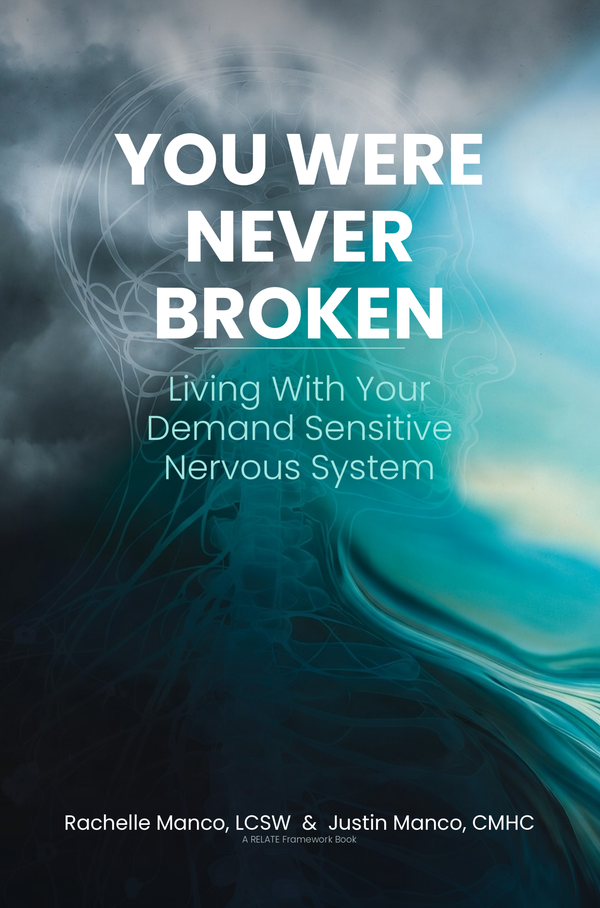
You Were Never Broken: Living With Your Demand Sensitive Nervous System
Paperback: $16.99 · Kindle: $9.99
Order on AmazonWhy this book exists
Most PDA resources are written for the people around you: your parents, your partner, your therapist, your teachers. They describe what you look like from the outside. The avoidance. The refusal. The inconsistency. What those resources rarely do is describe what the experience feels like from the inside. The gap between what you can see needs doing and what your body will move toward. The shame of not being able to do things that look simple. The exhaustion of performing competence for eight hours and having nothing left.
We wrote this book because that inside experience needed its own language. Not clinical language about you. Language for you.
RELATE was built in residential treatment and intensive outpatient settings. The clinical framework works. But most adults with PDA profiles will never walk into a residential program. Many will never find a clinician who has heard of PDA, let alone one who knows how to work with it. Waiting for the system to catch up felt like asking people to keep drowning while someone built a boat. So we wrote the book.
Who it's for
This book was written for adults who have a PDA profile. Some of you have a formal diagnosis. Many of you don't, and may never get one, because the diagnostic path for PDA in adults is inconsistent, expensive, and often inaccessible. If the description fits, if your nervous system responds to demands the way this book describes, the framework applies regardless of what's on paper.
You may already have other diagnoses: ADHD, autism, anxiety, depression, CPTSD, or some combination. PDA frequently co-occurs with these or gets mistaken for them. This book doesn't require you to sort all of that out before it's useful.
For adults who know exactly what they need to do and cannot make themselves do it.
What's in it
The book is built in five parts. Part One is recognition: what's been happening in your nervous system, why nothing you've tried has worked, and why the premise you've been operating from was wrong the entire time. This is not a pep talk. It's a mechanical explanation of why willpower fails against a threat response.
Part Two introduces two concepts that change everything: the Observer and the Critic. If you have a PDA profile, you have an internal voice that narrates your experience. And you have another voice, sitting right next to it, that turns every observation into a judgment. Understanding the difference between these two, and learning to hear which one is talking, is the single most important skill in the book.
Part Three takes the six RELATE pillars and translates them for self-directed use. This is not a clinician using the framework on you. This is you using the framework with yourself. Each pillar is adapted for the specific challenges of being both the person implementing RELATE and the person it's being implemented for.
Part Four applies the framework to the places where demand sensitivity actually lives in adult life: work, the backlog of things that pile up (healthcare, money, administrative tasks), relationships and intimacy, home environment and screen use, and substances. These are the chapters that get specific. Not theoretical. Not motivational. Specific to the situations you're actually in.
Part Five is honest about what comes next. This book is a beginning, not a complete solution. It covers how to find a clinician who understands PDA, how to bring this framework into an existing therapeutic relationship, what to consider if you're also a parent, and what the path forward looks like when the path isn't linear.
What this book is not
It's not therapy. It's not a diagnostic tool. It's not a substitute for professional support. The RELATE framework is evidence-informed but has not been validated through randomized controlled trials. We are transparent about that because you've probably been given confident answers before that turned out not to fit you.
If you are working with a therapist, this book is something you can bring into that relationship. Not as homework. Not as a demand. As shared language. If your clinician wants the full clinical framework, the RELATE Foundational Training Manual is written for professionals and available at relatepda.com.
One more thing
You don't have to read it in order. You don't have to finish it. If this book becomes a demand, it has failed at its own premise. Read what's useful. Return when you're ready. Skip what doesn't apply. The book will be here.
$16.99 paperback · $9.99 Kindle