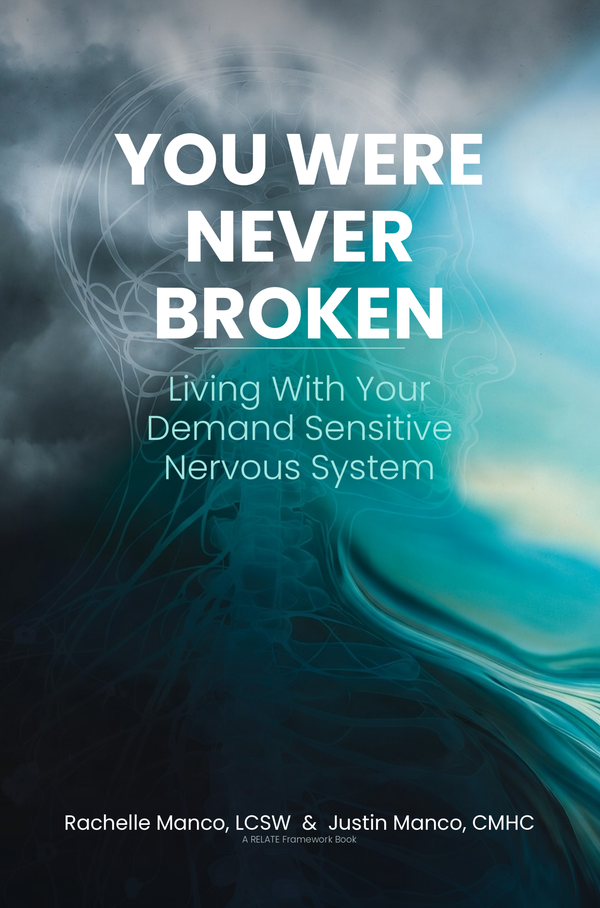
You Were Never Broken

Living with your demand sensitive nervous system. For adults who know exactly what they need to do and cannot make themselves do it.

Five parts. No required order. Start where you need to.

Part 1: The Nervous System

Why your brain treats a phone call the same way it treats a house fire. What demand sensitivity actually is, how it develops, and why willpower was never the missing ingredient.

Part 2: The Observer and the Critic

Two internal voices. The Observer reports what's happening without judgment. The Critic turns observation into verdict. Learning to tell them apart is the foundation of everything that comes next.

Part 3: The RELATE Framework

The six pillars of the RELATE framework, translated for self-directed use. Not how a clinician applies it to you, but how you apply it to yourself. Relationship, Empathy, Lower Demands, Adjust, Time, Environment.

Part 4: The Real Stuff

Work. Relationships. Intimacy. Healthcare. Substances. The areas where demand sensitivity doesn't just cause inconvenience but shapes the architecture of your life.

Part 5: Living With It

What it looks like to stop fighting your wiring and start building around it. Not a cure. Not a hack. A way of living that accounts for how your nervous system actually works.

You picked up this book because you're tired of the gap.

The gap between what you want to do and what your body lets you do. You can see the email. You know what it says. You know what you need to write back. And you cannot make yourself open it. Not because you don't care. Because something in your nervous system registers it as a threat, and your whole system locks.

You have been called lazy, avoidant, oppositional, unmotivated, and worse. You have internalized most of it. This book was written to both you and the internal voice that believes those labels. We know it's there. We're writing to both of you.

This book works whether you have a formal diagnosis or not. If the description fits your experience, the framework applies.

Frequently asked

How is this different from other books about PDA?
Most PDA books are written for parents or professionals. This one is written directly to adults living with demand sensitivity, built on a structured clinical intervention framework. It doesn't describe your experience from the outside. It speaks to it from the inside.
Do I need to read it in order?
No. The book is designed so you can start wherever you need to. If work is the thing that's falling apart, start with Part 4. If you want to understand what's happening in your nervous system first, start with Part 1. There is no wrong entry point.
Do I need a PDA diagnosis to use this?
No. Formal PDA diagnosis is inconsistent and often inaccessible, especially for adults. If your nervous system responds to everyday demands with avoidance, shutdown, or paralysis, the framework applies regardless of what is or isn't on paper.
What's the Observer and the Critic?
Two internal voices. The Observer notices what's happening without judgment: "I haven't opened that email." The Critic turns that into a verdict: "Because you're lazy and everyone knows it." Learning to hear the difference is foundational to self-directed RELATE work. The book teaches you how.
Is this a self-help book?
It's a framework book. It doesn't tell you to try harder, think positive, or build better habits. It explains why those approaches fail for demand sensitive nervous systems and gives you a structured alternative built by clinicians who work with this population every day.
Can I share this with my therapist?
Yes. If your therapist wants the full clinical framework, the RELATE Foundational Training Manual is available at relatepda.com/manual. Sharing the adult book with your therapist gives them a window into your experience that most intake forms never capture.
Want the clinical framework behind this book?

The RELATE Foundational Training Manual is the 196-page professional training document this book is built on. For clinicians, educators, and allied professionals.

View the Manual Contact Us